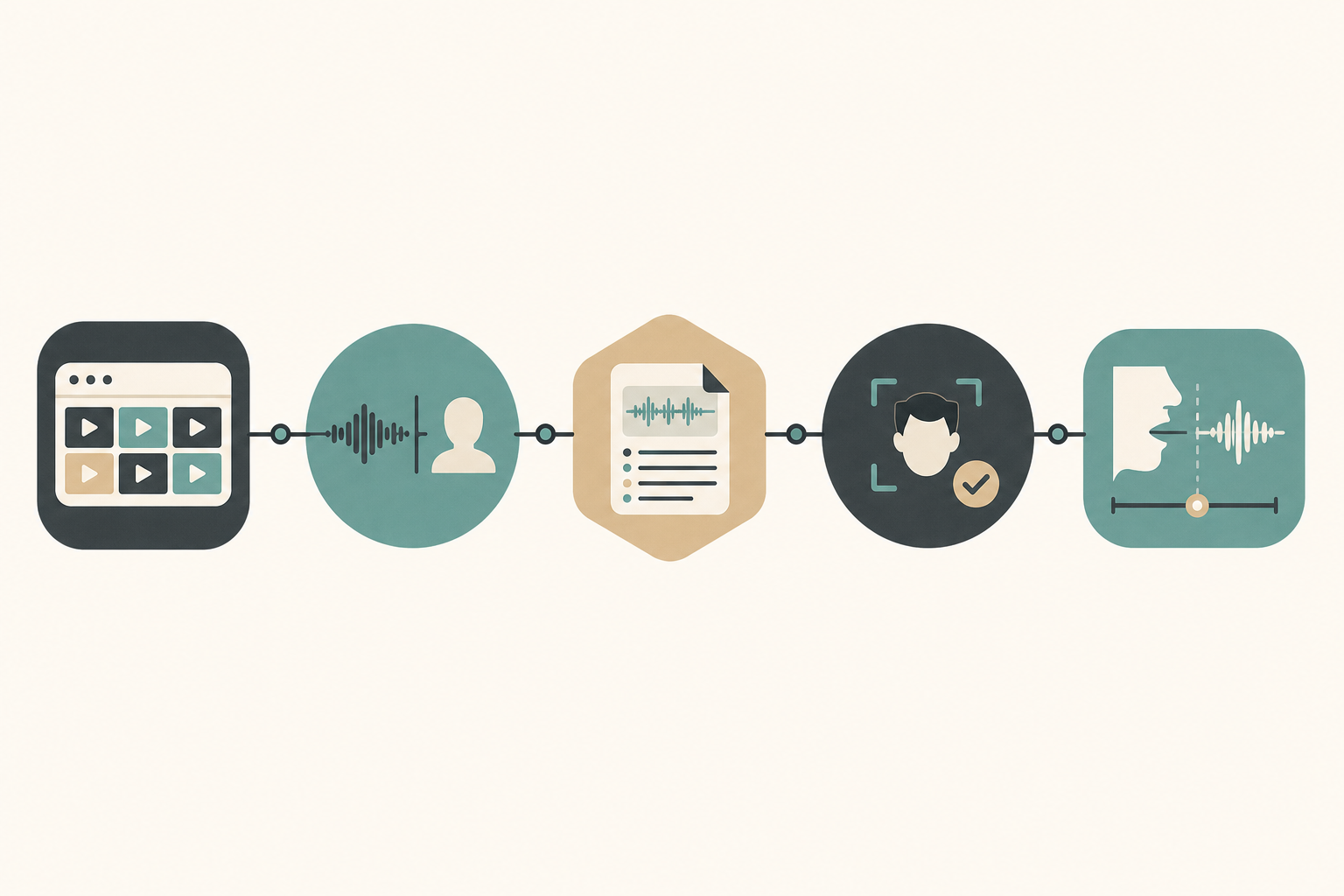
Multi-stage pipeline
We employ a multi-stage processing pipeline to achieve higher audio quality and more accurate text annotations while preserving lip–speech synchronization.
A bilingual corpus of high-fidelity, lip-synchronized speech–video pairs for video dubbing.
About
Collected from in-the-wild videos, VoxDub is curated for clean speech, reliable transcripts, continuous face visibility, and tight lip–audio timing. It covers Chinese and English, and can also support TTS and related audiovisual learning tasks.
Highlights
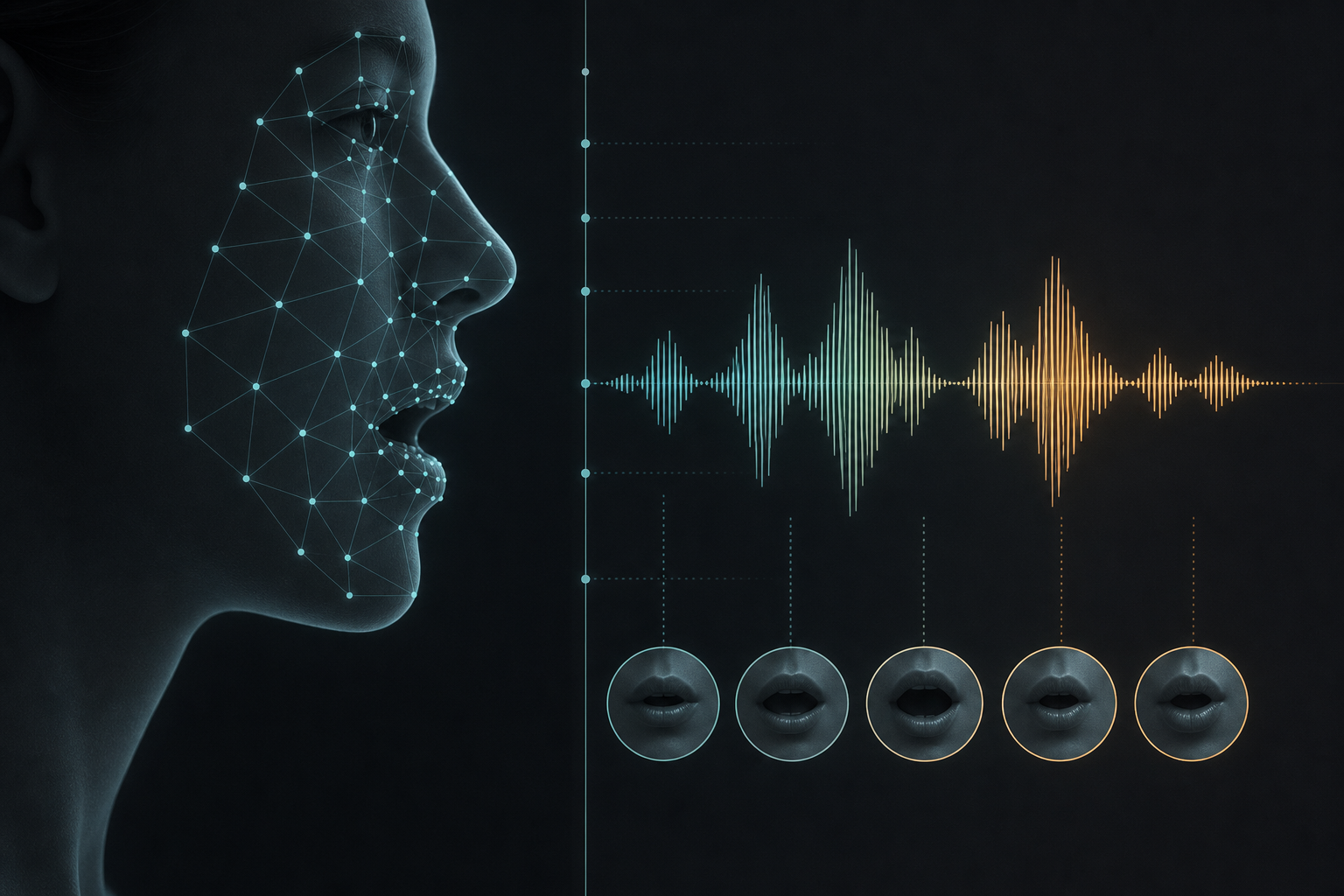
Compared with audio-only TTS corpora or loosely matched talking-face sets, VoxDub prioritizes clip-level usability for video-conditioned speech generation.
We employ a multi-stage processing pipeline to achieve higher audio quality and more accurate text annotations while preserving lip–speech synchronization.
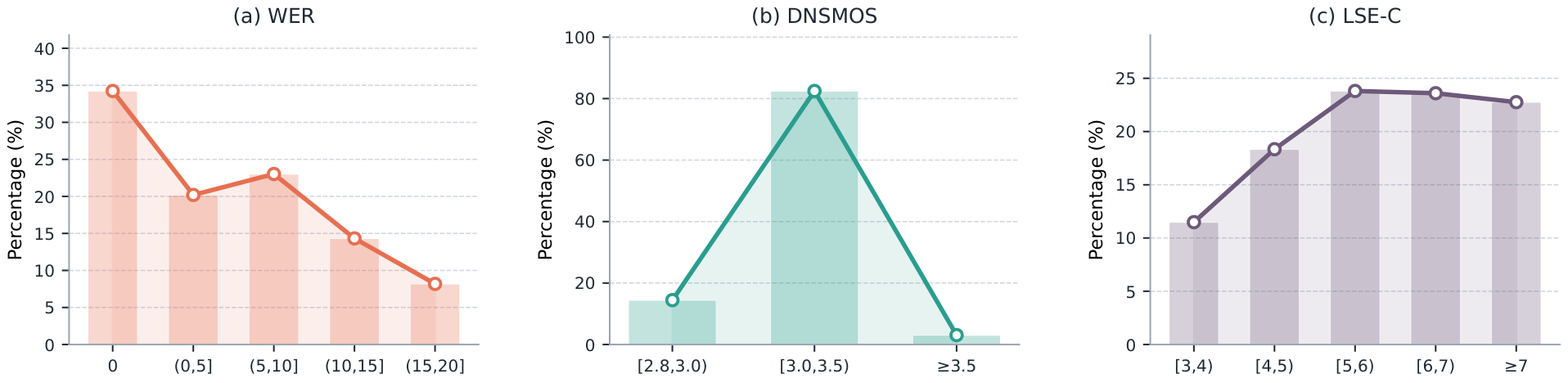
Nearly 35% of clips have zero WER, more than 80% score above 3.0 in DNSMOS, and over 70% achieve an LSE-C score higher than 5.0.
Access
VoxDub provides structured JSON metadata for every retained clip. Dataset acquisition instructions and additional details are available in the project repository.
Each source-video UID groups its clips, with a JSON record attached to every segment.
Each segment JSON contains
Detailed field descriptions and examples are included with the dataset repository.
Follow the README for the latest acquisition steps, release notes, and license terms.
github.com/voxdub-dataset/VoxDub Open on GitHub© VoxDub Dataset.
Released under CC BY-NC-SA 4.0.
VoxDub does not hold the audio or video copyrights; these remain with the original content creators. Users must decide whether and how to retrieve source media, and ensure that any use complies with applicable local laws and platform terms.
We aim to keep metadata accurate, but cannot guarantee that source videos will remain available.
Full licensing details and acquisition instructions are provided in the project repository.